Part 1 in red (Mexico City --> Teotihuacan --> Puebla --> Oaxaca with Mount Alban --> Pallenque)
For Alex's Birthday we decided to travel to Mexico. We contemplated on the destination for a long time and in the end it seemed that that Mexico would be a good compromise between a backpacking travel, seeing some historic sites and spending some time relaxing.
Rather than booking an official trip through an agency we decided, again, do do this in a DIY style and organise everything ourselves (well, actually Alex organised 99% of it...). So far so good and everything has worked out perfectly, without a single glitch (touch wood). The advantage of this type of travel is that you tent to learn and study (and as a result, remember) a lot more about all the places than on an organisd tour and also obviously you can tailor it to suit your time constraints and focus on the places that really interest you.
Our rote was to be as follows: Mexico City - Teotihuacan - Puebla - Oaxaca - Pallenque - Merida (Uxmal) - Chichen Itza - Perto del Carmen (Tulum) - Isla of Cozumel - Cancun
So far Mexico did not disappoint and turned out to be much more original than we expected. Below are some of our observations:
People
Mexican people seem very friendly and always happy to help and point out the right direction even without being asked. When we try to speak a few words of Spanish they seem to appreciate our efforts despite our broken accent and the fact that we don't understand most of what they are saying. Coming here we've read about the crime and violence but so far we have never felt threatened in any way or unsafe.
Cars & Traffic
Traffic is definitely a problem in all major urban areas. The roads are mostly in bad condition and the same goes for the cars. I've never seen so many original VW Beetles still on the road. In some places every 4th car is a Beetle. I'm not quite sure how they've managed to keep them running for so many years. All of this contributes to some really bad traffic jams.
Food
Authentic Mexican food turned out to be very different from what's being sold in Europe as Mexican. Sure enough there is plenty of tortillas, enchiladas, quesalidas, burritos chalupas etc, but they all seem to taste different from they European versions and the real delicacies seem to be various incarnations of mole, which is essentially a chili based sauce. Sauces are used in abundance with practically any dish and ever tortillas are always covered with some kind of sauce.
Drink
Mexican beer is excellent and cheap. Of course everybody nows Corona, but particularly good is the darker and stronger variety such as Modena Negra or Bohemia Negra. Wine on the other hand tends to be very expensive and only drank by foreigners. Which brings me onto the last point - Tequila. Tequila always seemed to me like that horrible shot of drink that you have just before closing time to finish your night off. This is definitely not the case here and I've definitely grown to appreciate Tequila. It's a drink that can be savored, like a good whisky, and in Mexico is customarily server with a shot of line juice and a spicy tomato sauce chaser.
Police presence
One thing we did not expect is the amount of police presence - everywhere. From the museums to street patrols and even restaurants. The other day I even almost got arrested at a museum for taking a picture. The police are everywhere and with full armor and live weapons and they look like they mean business and are ready to use their guns at the next available opportunity. The other day we were also passed by several army vehicles with solders in full combat gear with guns aimed and looking like they could also be quite trigger happy.
================
Mexico - population 21M, elevation 2.200 m; It's hard to imagine that this area was once covered by a big lake and swamps. Beginnings go back to mid XIV century, when a wandering Aztec tribe called Mexica saw an Eagle standing atop of a cactus and devouring a snake, which they had taken as a sign to settle down (eagle atop of a cactus with a snake is on the national flag); Aztecs (Mexico) built sophisticated city Tenochtitlan (now Mexico City) full of canals and good drainage system. Spanish invasion mid XVI lead by Hernan Cortes seen the city being destroyed and rebuilt in European style (at the time 300k population and valley accounted 1.5M); the canals and Aztec buildings were replaced by heavy colonial structures, which started sinking as the ground was soft (as it was an old lake) and the city was flooded frequently as the canals built over.
1 day in Mexico passed quickly walking around, visiting Palacio Nacional (from where we were kicked out for taking a photo of an old bike) and taking a city bus tour.

Cathedral from XVI century, is the iconic structure in the centre of Zocalo (main square)
National Palace in Mexico City, and of course and exhibit of la bicicleta... (hope you impressed, for taking this photo we've been kicked of from the museum)

Drinking with a friend in Zona Rosa, area full of restaurants and hotels
Frida Kahlo & Diego Rivera house - Frida is probably the most known Mexican painter, her paintings full of pain of not being able to have kids and physical pain caused by illness. She contracted pollo when she was a kid leaving her with left leg shorter and thiner. Then as a teenager she sustained a broken pelvis, legs and back in a bus accident. Not being able to continue to study medicine because of the health, she turned to painting. She married Diego (21 her senior, established already artist) in her early 20. They union was described as "elephant and dove" and was very turbulent (hate and love). They divorced after Diego had an affair with her sister Christina but re-mairing a year later. During her life, Frida's paintings were better known outside Mexico (she only exhibited once in Mexico). She joined and was an active member of the communist party. The house in pleasant Coyotan suburb of the Mexico City is very interesting (it consist of 2 houses, blue were Frida lived and white were Diego lived) and has a nice courtyard full of trees. On display there is a lot of Frida's work, photos, studio, kitchen and bedroom contain a lot of the personal items. In 2002 her life story has been turned into a film.

Frida Khalo's painting - Frida and Diego
============== Teotihucan - biggest ruins in this area, 50km north of Mexico City; Teotihucan was based on a grid plan, between AD100 and 600; the city covered over 20 square KM but only a small portion (2 sq km) has been excavated ; the centre point is Citadel believed to be the home of the ruler with the temple of Quetzalcoatl (inside there are 4 tombs, in each corner, not linked together containing 1, 13, 16, 20 sitting skeletons; the numbers are symbolic 13x20= 260 (in lunar calendar, 1 year = 260 days split into 20 periods/weeks, 13 days per period), 18x20 = 360 (=1 year in sun calendar)).
view from the top of Citadel
Pyramid of the Sun is the 3rd worlds largest (220m base and 70m high). 248 steps to climb to the top (overall there are 360 steps (1 step for each day in sun calendar) but they are underground as not entire pyramid has been excavated; it is a solid pyramid with no tombs; as the name indicated, it was dedicated to God of Sun; the pyramid was painted bright red colour

Pyramid of the Sun
Calzada de los Muertos (Alley of the Dead) is 2km long and runs from Citadel to Pyramid of the Moon; it is impressive; Aztecs believed that all the pyramids along the alley are tombs of the pre-historic gods therefore the name;
.JPG.jpg)
Alley of the Dead leads to the
Pyramid of the Moon standing on plaza de Luna, in company of 12 smaller temple platform (13 temples on the square symbolise 13 days in lunar period/week)

from the top of Pyramid of the Moon
==============
Puebla - despite 1.5M population it has a nicely preserved zocalo and the volcanos are visible on the horizon. It is only 2hrs drive from Mexico City, therefore it's not a surprise that it is a magnese for tourists. The restaurants, small shops and hotels are unique and full of character. The old centre itself has more than 70 churches; We found it a bit too touristy and too polished for our liking.

Puebla at sunrise
=================
Moving farther south (another 5hrs on the bus) we arrived to
Oaxaca - so far our favourite place. We stayed at the charming Aitana hotel - deco was so mexican with nice courtyard and delicious local food (tasty and cheap oppose to pizza, sandwiches and chips seen on menu in so many hotels);

More mexican food - a tlayuda
The pictures can't express the relaxed atmosphere, despite quite visible army presence (a couple of times we saw the trucks loaded with armed soldiers monitoring the city, they were not on a sightseeing tour, they meant business standing and holding the guns in the hands, pointing to the street). There is no particular building that can be photographed and shown, it is all a package: markets with no nagging sellers, small stands serving tacos and fried bananas, atmospheric restaurants.

A lot of preparation goes into the celebration of 1st of Nov - El Dia de los Muertos
The most famous dish in Oaxaca region is chicken in
chocolate mole (sauce), interesting combination and very rich; for starters there are chapulinos (grasshoppers) - we only once had enough currage and decided to order it, but because of our poor Spanish we got confused and instead of ordering chapulinos we ended up ordering chapules (stuffed chili) - so we've been saved.

More Mexican food - the famous Mole
===============
Monte Alban (white mountain) is standing on the flat top of the hill. It was a capital of the
Zatopec. It lasted almost 1000 years, from 400BC to 700. It is still a puzzle how they managed to flatten the hill top. Zatopec were one of the 1st people in Mexico to use calendar and writing; it is believed, that they were not warriors and didn't make human sacrifices to God;

Mt Alban ancient site of Zapotecs

============================
Palenque in Chiapas state are another ruins from IV century spread in the jungle, this time Maya's. Our 17hrs overnight bus journey wasn't too bad and we safely arrived at Palenque (according to the reports, this stretch of the road is known for the frequent bus robberies; those days there is a lot of the police patrols along the way and ID checks and bag searches became the norm). We arrived at 8am, it was already warm and very humid. After quick check in to the hotel, we had breakfast and headed towards the ruins served by the frequent mini-buses (7km).
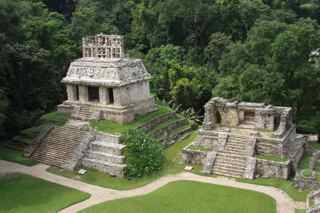
The ruins are magnificent, surrounded by a jungle. The 1st thing you see when you walk in is Temple of Skull (named because the columns are decorated with the sculpture of skull) next to Temple XIII with the tomb of the Red Queen (named that because her sarcophagus is red; inside the mask made from 1000 jade pieces was found)

The spectacular Temple of the Inscription has 8 levels and decorated with the inscriptions recounting the history of the Palenque and the process of building it. It contains the tomb of the king Pakal discovered only in 1952; Pakal was the most famous king, who lived 80 years - extraordinary age at the time where avg. live expectancy was 40 to 50 years;


el Palacio is another impressive structure, which was home of the ruler and the main priest. In the middle of the palace is the observatory. The palacio was covered by white stucco (plaster) and was called white skin.

Only a small part of the Palenque ruins had been restored, the main temples only. It's worth mentioning that the old cities were spread by long distances and the majority of the population lived in the wooden houses, sometimes with the stone base outside the temples, they didn't survive but the size of the cities can be estimated by pieces of pottery and day to day items found in the area.

So far we are positively impressed and not regretting doing the trip independently. The bus system is nicely developed , lots of hotels to choose from, people are friendly and happy to help. Our efforts to speak in Spanish seem to be appreciated - so far we are fluent in numbers and now usually know what we are ordering in the restaurants (previously our choices were based on the fact that it sounds nice, now we starting to order what we actually want). Still a lot of learning ahead of us if we want to make a conversation.


+-+Loosing+site+captain.JPG.jpg)
.JPG.jpg)


.JPG.jpg)